What It Takes to Move a City

This week, I attended Good Reason Houston's annual luncheon along with Houston's first Economic Mobility Summit, where a group of about 150 nonprofits, funders, and community leaders gathered to explore what it would take in Houston to improve upward mobility for families across the region. The conversation wasn’t only about income. It was about social, educational, and geographic mobility – what it takes for people to access opportunity and move toward stability and success.
The data were compelling, but what stayed with me wasn’t a policy idea or statistic. It was a truth woven through every presentation: mobility is built through connection. Who opens a door, who vouches for you, who helps you believe you belong...those relationships shape outcomes as much as skill or effort ever could.
That truth isn’t abstract for EMERGE. It’s our daily work.
Where EMERGE Fits in the Bigger Picture
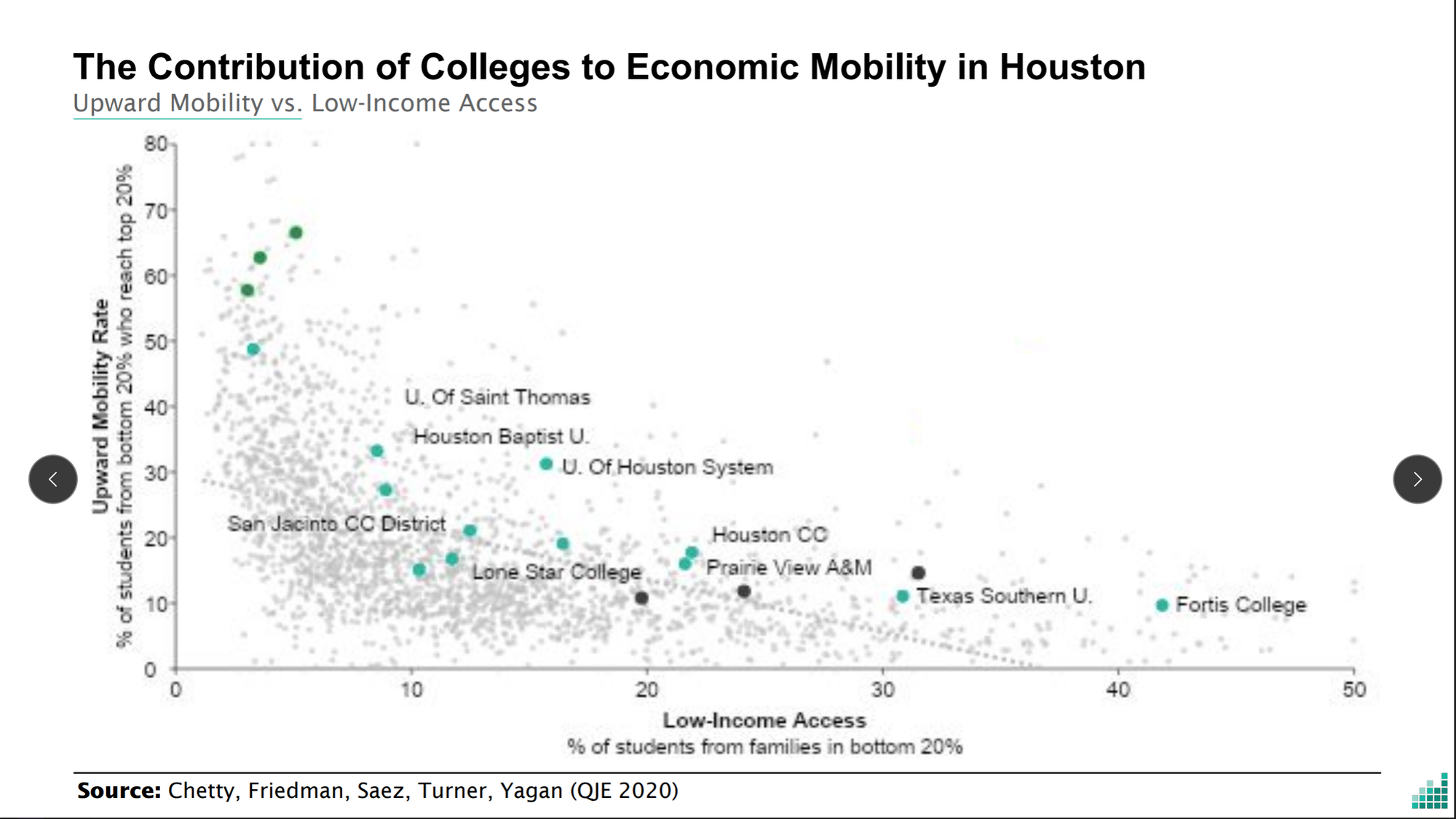
At the summit, one slide captured the challenge perfectly. It mapped colleges based on two measures: how many low-income students they enroll and how far all students move up the income ladder after graduation. The schools in the top left corner are the ones we prioritize. These are institutions whose graduates see real upward mobility. And our focus is a critical one: we’re working to get more students from low-income families there.
Our work pushes the whole system toward that corner. We’re helping more students from low-income families reach those high-mobility colleges, and we’re building the support network that helps them thrive once they arrive. The scatterplot shows why that matters: for Houston to become a city of mobility, we need more schools that produce high economic mobility and more students from low-income families able to reach them.
If you’re curious, here’s the full deck from the event. It’s a window into the broader landscape we’re part of and a reminder that what EMERGE contributes is both local and systemic.
The Power of Connection

This week, that network came to life in real ways.
At our mentor–mentee Halloween gathering, I watched mentors do what data can’t: normalize the unknowns, share personal advice, and make college feel navigable. A student walked in uncertain and left knowing exactly how to follow up with an admissions rep after submitting an application.
At a home fundraiser, students, alumni, funders, and board members came together to celebrate EMERGE’s work. The conversation was full of pride and belief. Funders spoke about why they trust EMERGE, citing consistent outcomes, a clear model, and a team that leads with care. Students and alumni shared what that commitment has meant in their own journeys. That trust and connection turned into introductions and follow-ups that will open more doors for students still coming up behind them.
And one small but powerful moment stood out. Marie, an HISD senior, asked a board member to write her a letter of support. It was a bold ask across lines of income and position — a student claiming her place in a wider network and giving someone else the chance to step up for her. That’s what social capital looks like in practice: relationships transforming confidence into opportunity. Shout out to Jalon and Jamie for your incredible support of Marie! It’s clear you all have empowered her to put herself out there and make big asks.
Building Capacity for Connection

Getting into a high-mobility college is necessary, but success there depends on more than academics. It’s about belonging, networks, and the ability to navigate spaces that may feel unfamiliar while staying grounded in who you are.
Every team at EMERGE plays a part in building that infrastructure of connection:
- Program staff help students find the language and confidence to build new networks while staying rooted in their identity.
- Development and Communications connect our story to the people who can invest, amplify, and advocate.
- People, Operations, and Finance make sure the systems behind the scenes are seamless so the relationships up front can thrive.
When we talk about economic mobility, this is what it means in practice: supporting students as they learn to navigate new worlds and making sure those worlds are ready to receive them.
Moving the City Forward

As we move through this intense stretch of early decision deadlines, major events, and year-end fundraising, it’s easy to get caught in the pace of the work. But this week was a reminder that every mentor conversation, donor meeting, and student milestone is part of a much larger web.
Economic mobility isn’t just a statistic; it’s a system of relationships. It’s what happens when individuals, institutions, and communities move in sync toward equity.
If you have a few minutes, take a look at the deck and see what stands out to you. The data and stories put our work in context and make clear just how essential EMERGE’s role is in expanding access to high-mobility pathways.
Seeing ourselves within that bigger picture is part of how we keep moving this city forward, one connection at a time.